Back on your feet
Practise the real world somewhere a little kinder.
Videos on virtual reality for balance, stroke recovery, wayfinding, busy-place sensitivity and dementia care.
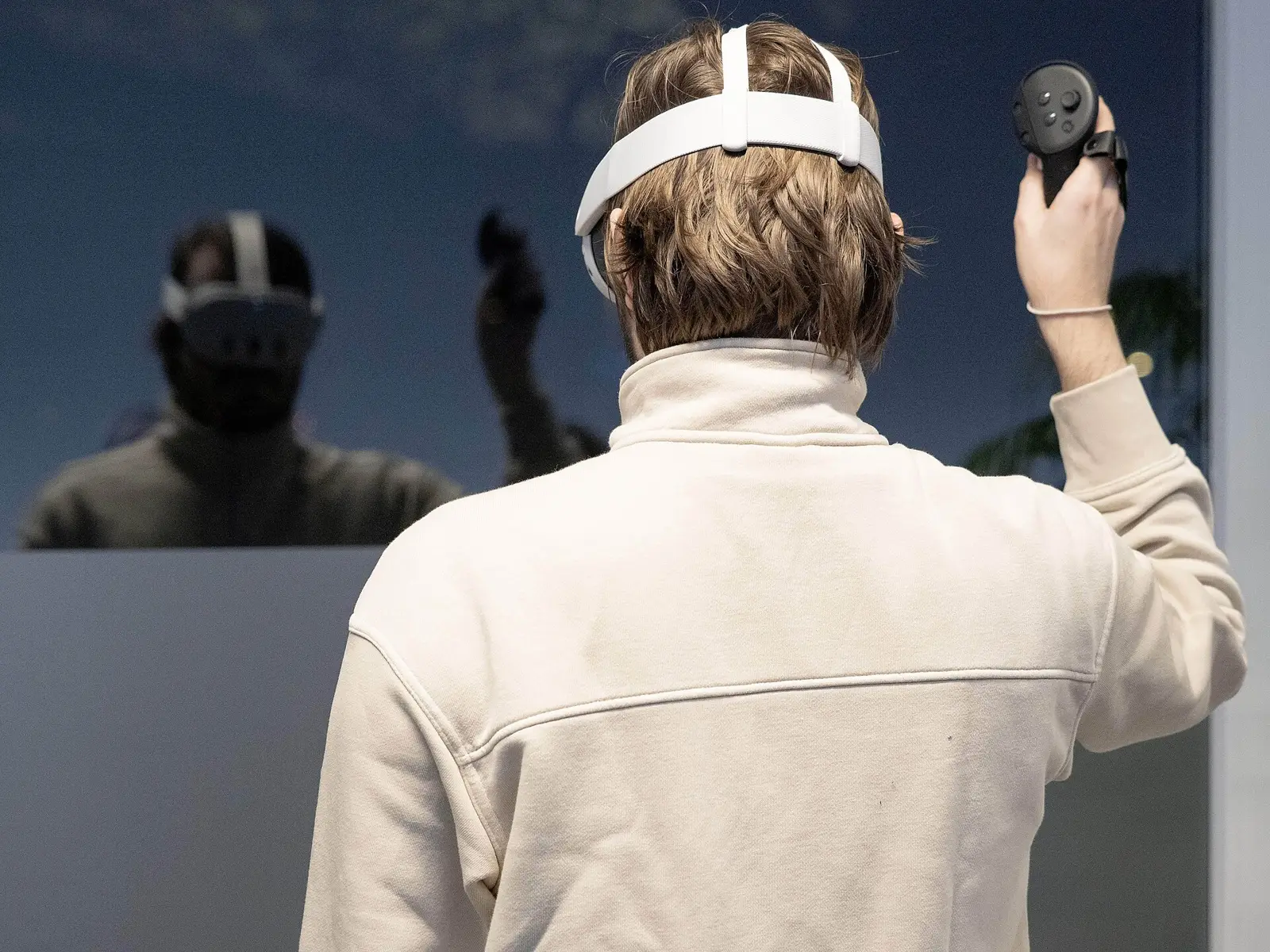
Image: credit
Recovery happens in the hallway, the supermarket and the crossing outside the clinic, places that are hard to rehearse safely. Virtual reality brings those places indoors, lets a therapist turn the difficulty up slowly, and records every step so progress isn't guesswork.
Five videos, five goals: steadier walking, stronger hands after stroke, finding the way again, coping with busy places, and feeling ready for the shops. Each page has the full script, chapters and the evidence behind it.

Explore
On this site
VR for balance and gait rehabilitation
How can a virtual street help someone walk more steadily?
VR mirror therapy after stroke
Can seeing both hands move help the brain rewire?
VR wayfinding and following directions
How do we train someone to find their way again?
Audio and visual desensitisation in VR
Can we gently retrain sensitivity to busy places?
VR for dementia therapy and community reintegration
Can a virtual shop trip help someone feel ready for the real one?
Watch
Navigating VR environments using footsteps on HVS 6D VR Omnidrive omnidirectional treadmill
Walking through a virtual world with real footsteps on an omnidirectional treadmill.
Video from the HVS Image channel on YouTube. It's loaded in privacy-enhanced mode and only plays when you press play.
From the journals
Recovery research roundup
Movement, ageing and repair, from new studies. Tap through to read the originals.
Pressing on the shinbone helped injured brains recover
Researchers gently compressed the shinbones of mice, 300 times at two per second, five days a week, after brain injury. More treated mice survived, damage was smaller, and they found the hidden platform in a water maze better than untreated mice. The effect needed a pressure sensor called PIEZO1 in bone cells, serum from treated mice protected other injured mice, and the approach also helped miniature pigs. Published in Nature Neuroscience.
Nature Neuroscience
Read the original at ScienceAlertAn Astragalus saponin after traumatic brain injury
A Lanzhou University group gave astragaloside IV to male C57BL/6 mice after controlled cortical impact, at 40 or 80 mg/kg every other day for four weeks, with GM1 ganglioside as the comparison treatment. The 40 mg/kg dose shortened water maze escape times, and NMDA receptor blockers cancelled the benefit, pointing to glutamate signalling. Published in Frontiers in Pharmacology.
Frontiers in Pharmacology
Read the original at Bioengineer.orgA 14-herb formula in rats with reduced brain blood flow
Rats with both carotid arteries tied off (9 sham, 12 model, 13 treated) received Modified Dioscorea Pills for 45 days. In the water maze the treated group pulled away from untreated model rats by day three and crossed the platform site more often at probe. The article is clear that this doesn't establish a treatment for human dementia.
Read the original at Bioengineer.org